House’s $1.5B Education Funding Reform Bill Is ‘Outstanding News for Haverhill,’ Says Vargas

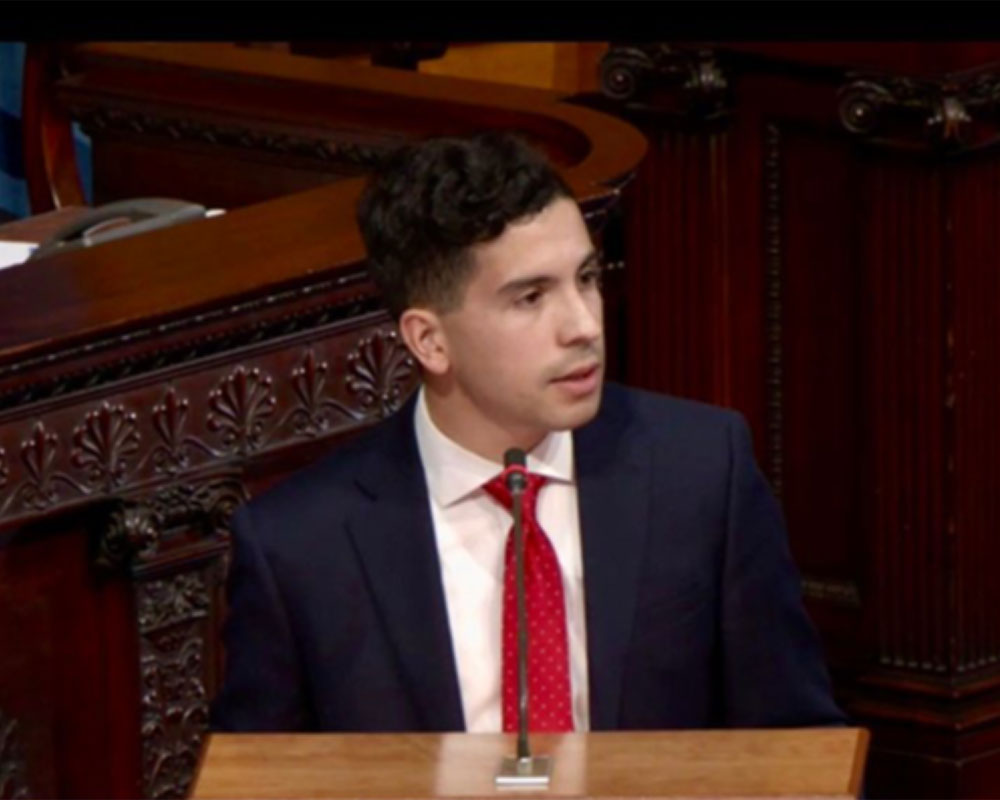
The Massachusetts House on Wednesday night unanimously approved a seven-year plan to pour $1.5 billion into the state’s public education system, moving legislation that has been the subject of persistent and passionate advocacy a step closer to the governor’s desk. Planned investments to support low-income students and English learners are a focal point of the bill—which state Rep. Andy Vargas, who sits on the Education Committee—says is a huge win for his home city of Haverhill. “In Haverhill, half of our students are low-income. The funding in this bill is vital for every student, but especially for the kids that rely on our education system to give them a fair shot in life,” Vargas told WHAV in a statement of the bill, dubbed the Student Opportunity Act. Praising the overall bill as a “once-in-a-generation change,” Massachusetts Teachers Association President Merrie Najimy said her union “will keep the pressure on in support of the Senate’s language” if the bill goes to a conference committee.


Baker’s Vape Ban Stands But Judge Outlines Conditions

In a ruling critical of how Gov. Charlie Baker went about banning the sale of all vaping products for four months, a Superior Court judge on Monday allowed the administration’s full ban to stay in effect, but only until next week unless changes are made. The ruling left the governor’s ban on marijuana vaping products untouched, but Judge Douglas Wilkins gave the administration until Monday to reissue the ban on nicotine vaping products as an emergency regulation. The change in approach would force the administration to write a small business impact statement and hold a public hearing no later than Dec 24. Under state law, the duration of the ban would also be limited to three months, expiring on Christmas Eve unless a hearing is held to extend the ban. Baker and Department of Public Health Commissioner Monica Bharel were sued by the Vapor Technology Association, Ian Devine and Devine Enterprise, Inc. following his decision in September to declare a public health emergency and have the DPH order a four-month ban on all in-store and online sales of vaping products in Massachusetts.

More Massachusetts Vaping Injuries Reported to CDC

The state health department on Wednesday reported 10 new cases of vaping-associated pulmonary injury and the health commissioner said officials remain unable to pinpoint the exact cause of the outbreak of illnesses. “Just like at the national level there’s no one thing,” Public Health Commissioner Monica Bharel said, according to the State House News Service. “We all want to find the silver bullet of what is causing this but unfortunately some used just nicotine, many use just THC, many used a combination of both and we just don’t have one thing yet that we can point to.”

The Department of Public Health announced that it has now reported a total of 29 cases—10 confirmed and 19 probable—to the the US Centers for Disease Control and Prevention (CDC). In those cases, state officials provided the CDC with evidence gathered from patient interviews and medical record reviews. “I’d like to emphasize that both at the state level and national level we do not know the cause of these vaping-related pulmonary illnesses,” she said.

Study Pegs Massachusetts Child Obesity Rate at 14.4 Percent

Obesity affects nearly 83,000 people between the ages of 10 and 17 in Massachusetts, or about 14.4 percent of people in that age group, according to a new report. The Robert Wood Johnson Foundation reported Thursday that the obesity rate for this group puts Massachusetts in the middle of the pack among states, with a ranking of 25th. That rate that has held steady over the years, sums up the State House News Service. The foundation says it has invested more than $1 billion over the last decade to address the problem, help more children to grow up at a healthy weight, and expand access to affordable healthy foods. “This new data shows that this challenge touches the lives of far too many children in this country, and that black and Hispanic youth are still at greater risk than their white and Asian peers,” President Richard Besser said in a statement.

Gov. Baker Stands by Vape Ban Decision, Says It Wasn’t Easy

Gov. Charlie Baker has been both applauded and threatened with legal action in the days since rolling out the first-in-the-nation ban on all vaping products, but on Thursday the governor said he had no regrets. “Once we had met with all the medical experts, to do nothing was just not a viable option,” Baker told the State House News Service on Thursday after an event in Everett where he talked up his housing legislation. Last week, Baker announced he would ban all flavored and non-flavored vaping products for four months while the medical community and federal health inspectors try to determine what has caused a spate of severe vape-related lung disease. The ban, which was approved by the Public Health Council, made Massachusetts the first state in the country to include tobacco flavored vaping products and both medical and non-medical marijuana in a ban on retail sales. Asked about concerns that the ban might foster a black market, Baker did not acknowledge a difference in the threat to public health between illicit and legal vaping products.

Passing Off Pet as Service Animal Akin to ‘Fraud,’ Says Legislator Pushing New Bill

Ellen Leigh was out with her service dog, Ricky, last month, when another dog wearing a working-dog vest tried to bite him, forcing the duo to quickly turn in the opposite direction. Leigh, an Arlington resident who uses a motorized wheelchair, told lawmakers on Tuesday that this was one of many encounters she’s had with pets whose owners misrepresent them as service dogs. While legitimate service dogs like Ricky are bred for their work and trained to be non-aggressive, Leigh said, pets without special training can become stressed in hectic, public environments and become aggressive, creating a hazard for service dogs and the people who rely on their assistance. According to the State House News Service, a bill filed by Rep. Kimberly Ferguson would make it a civil infraction to knowingly misrepresent a dog as a service dog or service-dog-in-training “for the purpose of obtaining any rights or privileges afforded to a person with a disability requiring the assistance of a service dog.”

Violators would be subject to a fine of up to $500, 30 hours of community service at an organization serving people with disabilities, or both, for a first offense. The penalty would increase for subsequent offenses.

Baker Declares Four-Month Ban on Vaping Product Sales

Gov. Charlie Baker on Tuesday ordered a four-month ban on all in-store and online sales of vaping products in Massachusetts, citing a need to learn more about health risks associated with e-cigarettes in the midst of a multi-state outbreak of lung illnesses. The ban, which is the first of its kind in the country, applies immediately to all flavored and unflavored vaping products and devices, including tobacco and both medical and non-medical marijuana. “We as a Commonwealth need to pause sales in order for our medical experts to collect more information about what is driving these life-threatening vaping-related illnesses,” Baker said. “We also need to better understand the inherent dangers of vaping both nicotine and marijuana. With all this information we can then develop a set of targeted measures and response.”

Since Public Health Commissioner Monica Bharel on Sept.

Lawmakers: Treatment Laws Need to Reflect Recovery Realities

Rallying with people in recovery, their families and friends, and advocates for people who struggle with addiction, state lawmakers on Monday called for the state’s laws around treatment and recovery options to keep pace with developments in science and research. As part of the Massachusetts Organization for Addiction Recovery’s annual Recovery Day event, Sen. John Keenan of Quincy and Rep. Tami Gouveia of Acton spoke to a group of hundreds about the possibilities for recovery and the ways state government can try to respond to the opioid epidemic and the growing need for treatment options. Gouveia and Keenan each touted legislation that they said would help make treatment more accessible and give recovery a better chance of taking root by requiring private insurance companies to cover up to 30 days of addiction treatment. Under current law, they must only offer coverage for 14 days, which supporters say does not allow users enough time to complete detox programs and enter the next phase of treatment. “When a person in the early stages of recovery is ready for additional treatment but is told by an insurance company they won’t pay for it, that is just wrong,” Keenan said.