House Approves Ban on Flavored Tobacco, Vaping Products; Vargas Rev. Sets Aside 30% for Prevention

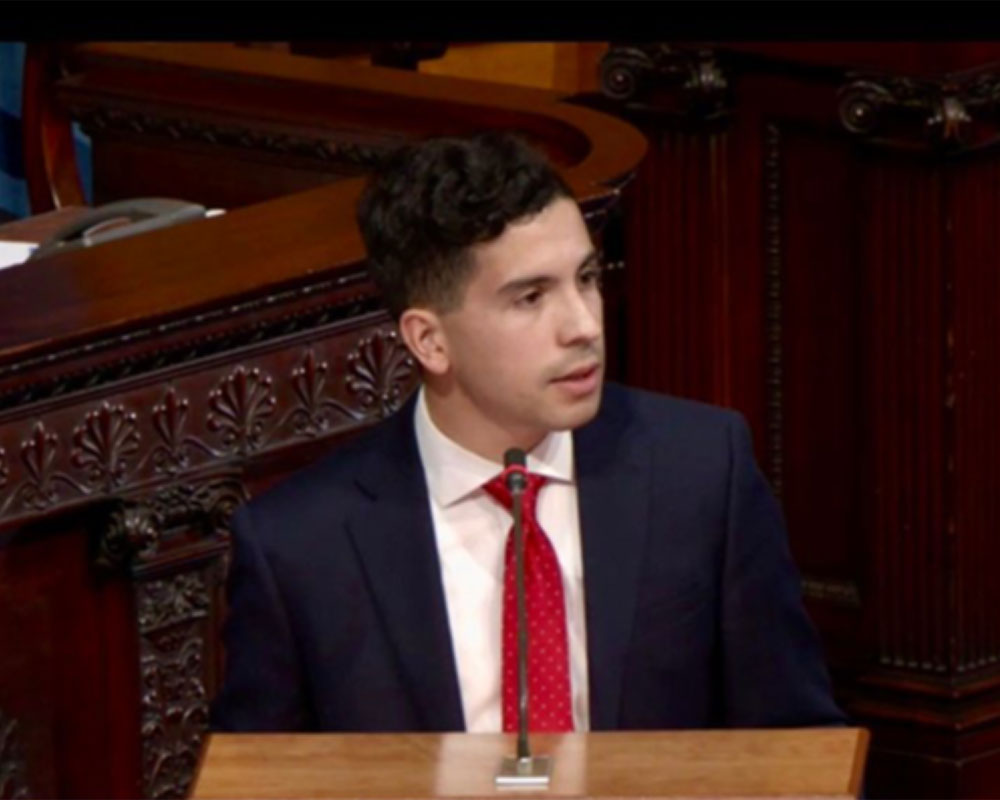
The Massachusetts House voted Wednesday to ban the sale of flavored vaping and tobacco products—including mint and menthol cigarettes—and to impose an excise tax on e-cigarettes. Rep. Danielle Gregoire, a main proponent of flavor ban legislation, said the vote marked “a chance to put an unprecedented nail in the coffin of Big Tobacco.” The bill passed on a vote of 126-31. Under a Rep. Andy Vargas amendment, the House adopted, 30 percent of the vape tax revenue — which lawmakers previously estimated at $10 million to $15 million per year — would be directed toward a trust fund that communities use for substance abuse prevention. The American Cancer Society Cancer Action Network said the bill would make Massachusetts the first state to restrict the sale of all flavored tobacco products, including menthol cigarettes. House Speaker Robert DeLeo described Wednesday’s vote as “a nation-leading step…to modernize our laws that regulate tobacco.”

The action in the House came almost 16 months after Gov. Charlie Baker signed a law raising the tobacco-buying age from 18 to 21 in an effort to curb youth smoking.


State Reports Third Vaping-Related Death

A Worcester County man in his 50s was the third Massachusetts resident to die of a vaping-associated lung injury, the Department of Public Health announced Wednesday morning. The man, whom public health officials did not identify, had reportedly vaped both nicotine and THC, the psychoactive compound in marijuana. DPH had previously reported the vaping-related deaths of a woman in her 40s from Middlesex County and a woman in her 60s from Hampshire County, both of whom reportedly vaped nicotine. “This disease is serious and potentially fatal and we are continuing to investigate the cause,” DPH Commissioner Monica Bharel said in a statement. The state has not said when any of the three deaths occurred.

Report: Grand Jury Exploring Municipal Pot Agreements

A federal grand jury is looking into the mandatory agreements and payments between host communities and marijuana businesses, according to a report in the Boston Globe, delving into an issue that state regulators and legislators have also been wrestling with. The Boston Globe reported Monday night that at least six communities—Great Barrington, Eastham, Leicester, Newton, Northampton and Uxbridge—have received subpoenas from U.S. Attorney Andrew Lelling’s office seeking details on the communities’ host community agreements with marijuana businesses. State law requires applicants for marijuana business licenses to enter into a host community agreement before the Cannabis Control Commission will consider an application. The law stipulates that those agreements cannot run for more than five years and that the community impact fee paid to the municipality by the licensee cannot exceed three percent of the establishment’s gross sales. But the CCC has wrestled with the policy for more than a year now as entrepreneurs, lawyers and lobbyists have shared stories about cities or towns demanding a greater percentage of gross sales or other asks that would not appear to comply with the language of the law.

Judge Orders Vape Ban Lifted for Medical Marijuana Users

A Superior Court judge ruled that Gov. Charlie Baker’s emergency regulations banning the sale of all vaping products “are very likely invalid” as they relate to medical marijuana patients and ordered that the state may not enforce its prohibition on “marijuana vaping products to medical marijuana card holders” starting next Tuesday afternoon. A group representing medical marijuana patients intervened in the challenge to Baker’s temporary vape sales ban, arguing that the Cannabis Control Commission, not the Department of Public Health, is the only state agency that can regulate marijuana products. The group’s premise is that the 2017 law that created the CCC “transferred authority to regulate all legal marijuana” from DPH to the CCC and that the Legislature was clear in its law that the CCC should be the lead regulatory body. Judge Douglas Wilkins, in an order issued Tuesday, agreed and said the DPH “likely exceeded its authority by banning vaping products used by medical marijuana card holders.”

According to the State House News Service, Wilkins ordered that the administration be “preliminarily enjoined from implementing and enforcing” its emergency regulations as of 12:01 p.m. on Tuesday, Nov. 12.

RMV: Backlog of ‘Serious Offenses’ Cleared

A violation-processing department within the Registry of Motor Vehicles still has about 12,000 work items requiring manual review, some of which may warrant license suspensions, but staff have cleared out every “serious offense” from the backlog, officials said Wednesday. After a fatal crash and an ensuing scandal this summer revealed a backlog of missed violations at the RMV, staff have been working to issue new suspensions and update work processes to prevent a similar issue in the future. The Merit Rating Board now has an internal process every day to review the latest digital alerts about driver citations and determine which ones relate to the most egregious cases, according to Interim Director Paolo Franzese. “We’re up to date on those at the moment,” Franzese told the Merit Rating Board, a three-member panel that is tasked with overseeing the RMV department of the same name. “None of the 12,000 contain serious offenses.”

The number of work items — which does not correspond directly with the number of citations that need attention — was down to 12,300 as of Monday, compared to a high of 21,700 in August, Franzese said.

State: Ban Costing Vaping Stores Up to $8M in Sales

The Baker administration projects that a three-month ban on retail nicotine and marijuana vaping products has the potential to cost private businesses $7 million to $8 million in sales. The estimate was included in paperwork filed with Secretary of State William Galvin’s office by the Department of Public Health on Monday. The filing was required to implement an emergency regulation in compliance with a Superior Court judge’s order that questioned the way Gov. Charlie Baker implemented his temporary ban on vaping product sales. DPH officials said the ban would cost the state about $35,000, and the out-of-pocket cost to comply with the ban would be “minimal” for the private sector, but had the potential to cost store owners up to $8 million in lost sales. The American Vaping Association has said that nicotine vaping business owners in Massachusetts employ 2,500 people as part of a $331 million industry.

Bill Aims to Convert ‘Zombie Properties’ Into ‘Good Housing’

Every city in Massachusetts has one or two, and in Lawrence, there are hundreds, Mayor Daniel Rivera said Thursday: Vacant properties that aren’t being developed, because their owners are tied up in land court or the ownership is otherwise unclear. “They’re either zombie properties or in bureaucratic no-man’s land, where people really can’t access them,” Rivera said, adding that those properties are a threat to vagrants and become a threat for arson, for example. Rivera appeared before the Community Development and Small Business Committee, pitching lawmakers on a bill that aims to make it easier for blighted and abandoned properties to return to the housing market and boost struggling neighborhoods in the process. According to the State House News Service, the Lawrence mayor said walking by the same vacant building for years can result in “a sense of hopelessness in despair” for neighbors and send a message “that no one cares.” Revitalizing those vacant properties into new housing, he said, could strengthen communities. Filed by Rep. Antonio Cabral, the bill would form a commission to study strategies for improving the quality of housing stock in weak markets, task the Executive Office of Housing and Economic Development with developing a “capacity building program” to help cities and towns with neighborhood stabilization and housing improvement efforts, and create a “spot blight rehabilitation program” focused on abandoned and vacant residential properties.

Concussion Threat Behind Youth Football Ban Bill: ‘Football Is to CTE What Smoking Is to Lung Cancer’

A state lawmaker from Westport on Tuesday pitched his bill that would prohibit tackle football before eighth grade as a way to protect children from brain injuries, while opponents countered that it would infringe on parental decision-making. “Increasingly, science is telling us that hits to the head are bad, and that the sooner they start, the younger you are when they start, they worse it is for you,” Rep. Paul Schmid told the Public Health Committee, according to the State House News Service. Schmid’s bill would prohibit children in grades seven and below from playing, practicing and otherwise participating in “organized tackle football,” with flag football and other non-tackle varieties still allowed. Schools, leagues or other entities that violate the prohibition would be subject to a fine of up to $2,000 per violation, with penalties increasing for subsequent violations and for “serious physical harm” to participants. The bill is cosponsored by 16 other representatives in addition to Schmid—six Republicans and 10 Democrats.