
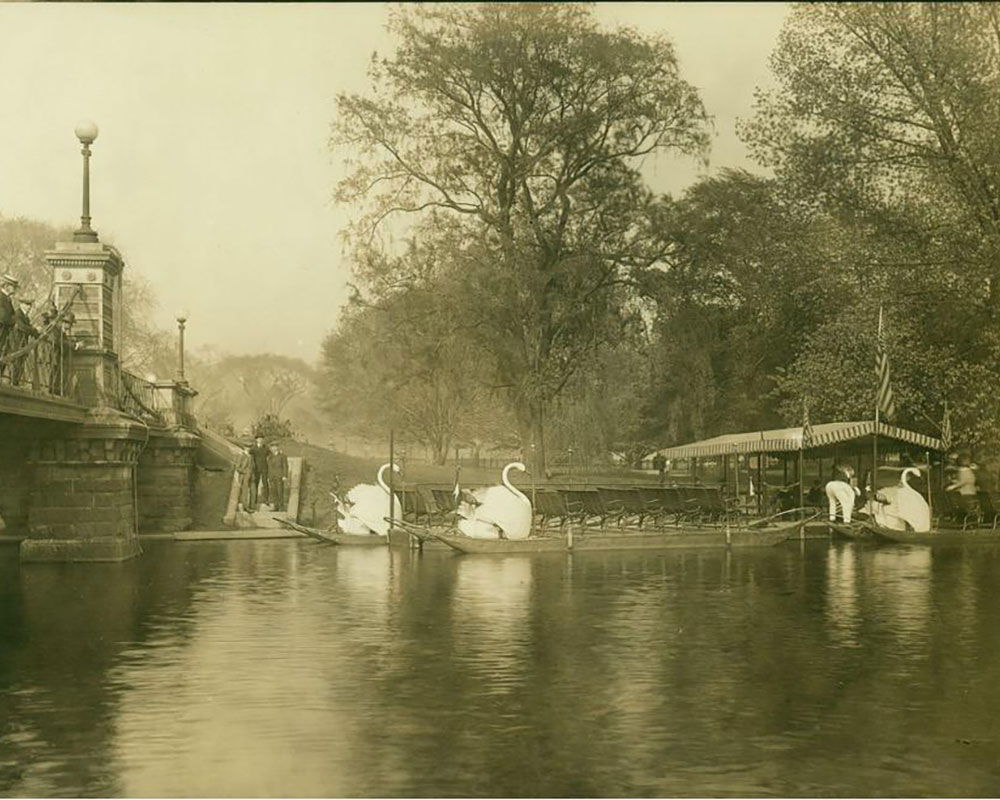
The archives of Boston’s legendary Swan Boats—in photographs, letters, objects and more—are finding a home in Haverhill on the eve of the boats’ 150th anniversary.
Historic New England Center in Haverhill will hold the collection, assembled and cared for by the Paget family, which has owned and operated the Swan Boats for generations. The nonprofit, whose Essex Street center opened last June, said it is working on the “living archives” with fourth-generation owner Lyn Paget. Historic New England plans to catalogue the collection in stages, with selected materials to be shared online as the work progresses. The organization is also exploring future exhibitions, programs, publications and other opportunities to bring the collection’s stories to wider audiences.
“The Swan Boats are woven into the cultural history of Boston in a way that is both deeply personal and remarkably enduring,” said Historic New England President and CEO Vin Cipolla. “For generations of Bostonians and people from around the world who have lived, studied, worked and visited here, a ride on the Swan Boats is a memory shared with parents, grandparents, children and friends. This collection gives us the opportunity to preserve those stories, and to explore the many ways the Swan Boats have intersected with the life of the city.”
The Swan Boats began operating in the Boston Public Garden in the 1870s, when Robert Paget received permission from the city to introduce rowboats to the lagoon. The family later expanded the operation and developed the distinctive swan-shaped, pedal-powered vessels that have become synonymous with the Public Garden. Over nearly 150 years, the Swan Boats have welcomed generations of residents and visitors from around the world, becoming both an enduring Boston tradition and a key part of the story of one of the country’s oldest and most significant public landscapes.
For Lyn Paget, finding a permanent home for the family archives was an opportunity to ensure that materials accumulated over generations would be preserved and understood in a broader historical context. “I’ve always known that these materials were important, but working with Historic New England has helped me see the archives in a completely different way—as a living collection of stories about the Swan Boats, our family and all the places where they intersect with Boston’s history,” Paget said.
The collection includes approximately a century of newspaper clippings preserved in family scrapbooks, photographs dating from the late 19th century through the pre-digital era; family and business records; and ephemera and objects related to the Swan Boats’ history and operation. They offer glimpses into the events, traditions and personalities surrounding the Swan Boats and Boston Public Garden, from arts festivals in the 1950s and ’60s—when the boats operated at night and, on one occasion, hosted a Boston Symphony performance—to notable visitors and the everyday memories of generations of residents, students, workers, and visitors who have experienced the Public Garden.
Historic New England and the Paget family have also begun collecting oral histories from family members, former employees and the public, expanding the archival record beyond photographs and documents to include the memories of people who have been part of the Swan Boats’ history.
Highlights from the archives were shared this fall as part of the 2026 Historic New England Summit. Two weeks ago, Lyn Paget presented “Paddling Through the Past: Boston’s Swan Boats Celebrate 150 Years.”