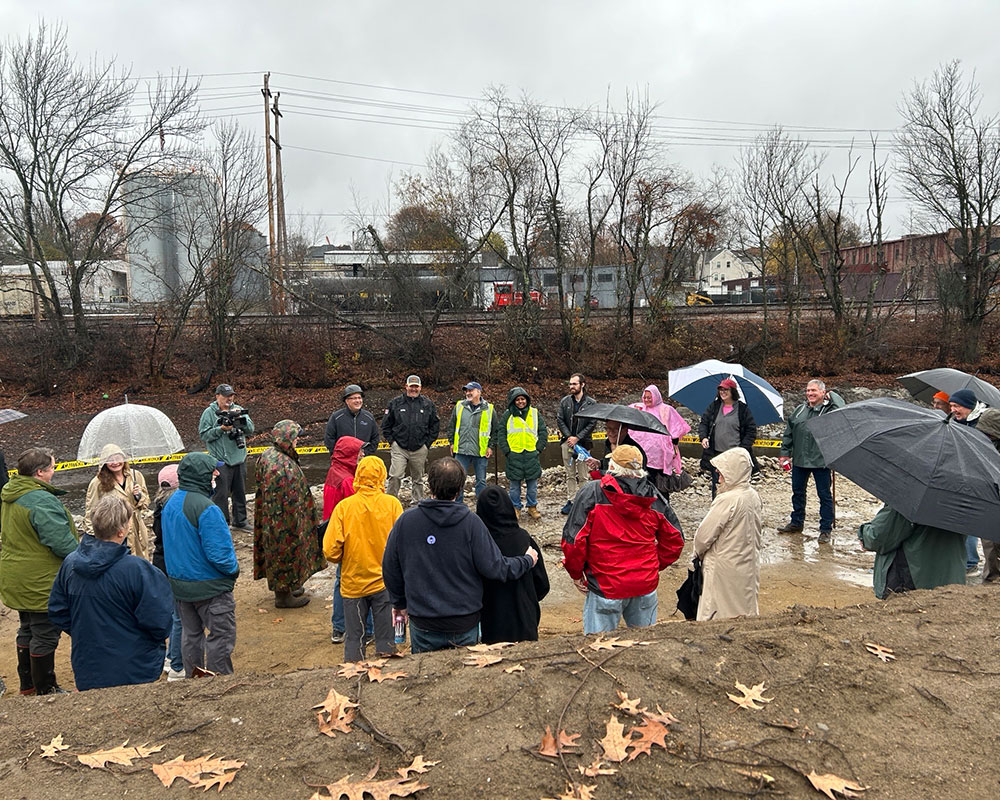

More than two dozen residents turned out in the rain Saturday to learn more about Haverhill’s Little River dam removal project, with at least one previous skeptic coming away with confidence in the project.
Following a presentation by Haverhill Environmental Health Technician Robert E. Moore Jr., consultants and contractors, Wilbur “Bill” Mahoney said his outlook has changed.
“I was totally against this. I thought it was foolish and a waste of money, but talking to you guys today, I can see some of …you swayed me. No, truly, I thought it was just going to be hell bent, drain the river,” he said.
Haverhill Public Works Director Robert E. Ward said he appreciated Mahoney’s comment, saying going ahead with the $7.3 million project was a “tough decision.”
Moore told the about two dozen attendees the project lowers the 100-year flood plain, improving conditions along LeBlanc, Little River and Apple Streets, but maintains a minimum water depth. “At its driest, the design calls for Little River to be no lower than 18 inches deep and the base of it will be 18 feet with the slopes going up to about 25-foot width.”
Water levels will be maintained by various measures including a series of six to eight weirs, placed with, what contractors described as, GPS “millimeter accuracy.” These will allow for fish migration and kayak and canoe access.
Moore repeated what he told WHAV listeners Friday, one surprising find is the 1870-era dam had a wooden, tongue and groove, timber backing behind its stone. He also addressed various concerns, including worries dam removal will affect water levels far upstream.
“The zone of influence really for the effect of the dam stops at about the MBTA bridge. So, what you normally see up at Clement Farm and beyond is not intended to be changed at all by this. You have a run-of-the-mill, run-of-the-river kind of mill impoundment. It is kind of common, elongated, stagnant water, low-dissolved oxygen, not the best water quality. With the removal of the dam, you’re going to have reoxygenated water. It likely changes the type of fish you may have in there, but the influence hydraulically peters out by the MBTA bridge,” he explained.
Little River is already stocked some years with trout at the Rosemont Bridge. In fact, Moore added, the new Rosemont Street bridge project included a break in the guardrail for placing a canoe or kayak in the water.
Luciano’s Excavation project Superintendent Kyle Curley offered even more assurances to fishing enthusiasts.
“There are some fish pools designed specifically in the bottom of the river that will hold more water than other areas. So, that way the aquatic life that we hope to see here in the future has a place to go,” he said.
Curley also explained that while trash and debris will be removed from the river bed, it will be done methodically because, in his words, “that’s part of the structure of the existing river now.” Luciano’s Senior Project Manager Eric Mangasarian explained cleanup will take place with the aim of not creating downstream sediment migration.
Officials said recreational benefits include boating, with a boat launch in the back of Cashman’s Field and a greater variety of fish and fishing opportunities. Other environmental benefits are reduced flooding potential, increased tree cover and native vegetation downtown and a restored ecosystem.
Moore acknowledged some property lines will change as the high-water mark changes.
The work is expected to progress for another year with reconstruction of the Little River corridor, removal of contaminated sediment, shaping the waterway channel and restoration of disturbed areas with native seed mixes and installation of shrubs and trees. Site monitoring continues through the spring of 2032 to check plant survival, site stability and wildlife usage.
Besides Moore, Ward and the contractor, representatives from consultant Fuss and O’Neill, Mayor Melinda E. Barrett, Ward 3 Councilor Devan M. Ferreira and Conservation Program Manager McKayla Arsenault took part.