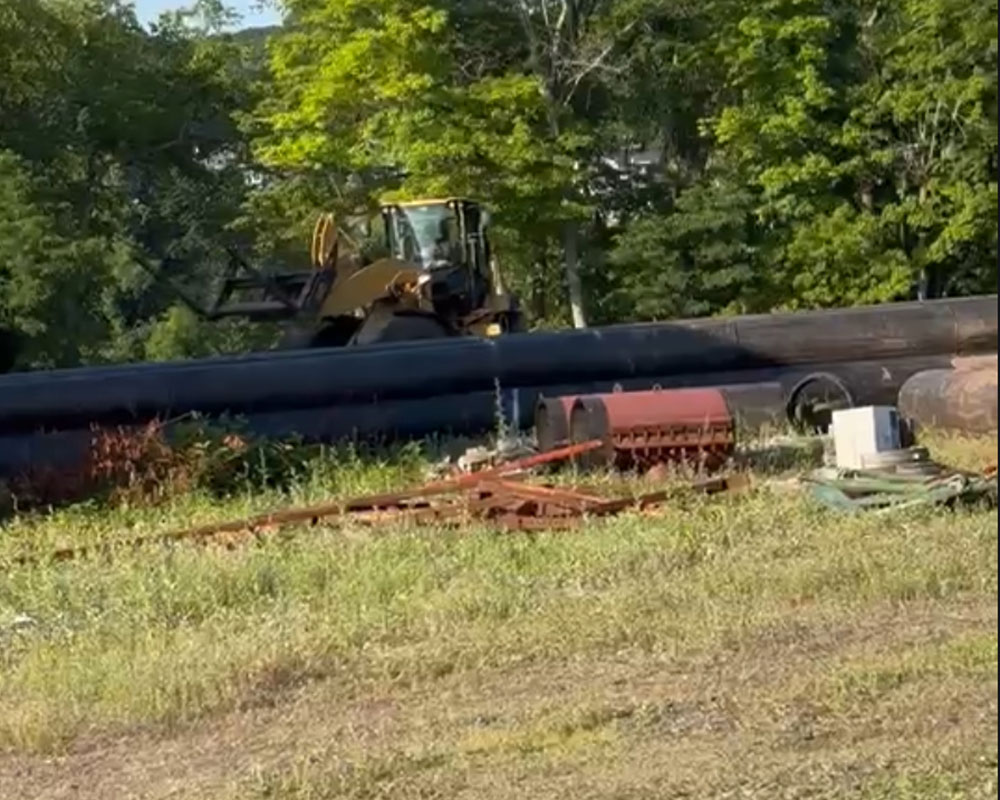

Haverhill’s recent force main sewer break, that caused untreated sewage to be discharged into the Merrimack River, may help bring millions in federal infrastructure help.
On the heels of Tuesday’s aid plea to U.S. Environmental Protection Agency Administrator Lee Zeldin with Congresswoman Lori Trahan, Congressman Seth Moulton said the House Committee on Transportation and Infrastructure adopted his amendment to raise the ceiling for upgrading Haverhill’s wastewater infrastructure from $40 million to $50 million.
“Haverhill’s sewer system is one of the oldest in the country and a temporary bypass is not an acceptable solution,” said Moulton, referring to construction of two 24-inch mains to substitute for two collapsed portions of a 42-inch, concrete line. He added, “These CSOs are polluting our environment and compromising public health, and we need to work across all levels of government to find a permanent solution. The funding that is authorized by my amendment, if funded by appropriators, will make sure we finish the job once and for all. No family in Massachusetts should have to wonder if their beach is safe to swim at again.”
Separately, Trahan and Sens. Edward J. Markey and Elizabeth Warren introduced a bill, the Water Emergency and Technical Assistance Act, to amend the Safe Drinking Water Act and the Federal Water Pollution Control Act to provide technical and financial support to water treatment facilities during emergency situations to prevent and mitigate threats to public health, such as exposure to contaminants.
“Haverhill showed us what happens when a century-old system fails and the federal government is nowhere to be found. Cities were left to fight sewage flowing into the Merrimack with local dollars and borrowed time,” said Trahan. “Our bill fixes that. It puts real federal money on the table the moment an emergency like this hits, so no community has to face it alone.”
Trahan noted she also introduced the bipartisan Stop Sewage Overflow Act to grow federal investment in combined sewer overflow projects to $500 million annually and secured direct community project funding for such work in Haverhill, Methuen and Lowell.
“Water system emergencies spell disaster for their communities—they’re expensive, bad for business and dangerous to public health. Our communities deserve clean water and quick access to support in response to emergency situations that put their health and economies in danger,” said Markey and Warren in a joint statement.
Moulton’s amendment relates to the Water Resources Development Act of 2026, which must be reauthorized by Congress every two years.
“For days, an estimated eight million gallons of untreated sewage flowed daily into the Merrimack River, closing beaches in Ipswich, Newburyport, Salisbury and Essex, and prompting an emergency shellfishing closure that left clammers empty-handed during the height of the season,” Moulton’s office said in a release. It noted “permanent repairs to the force main are still underway, and subsequent rainstorms have continued to raise bacteria levels in the river.”
The money is not a sure thing. Moulton’s office noted a future appropriations bill would also be required before the city can draw on the additional federal support.