
(Additional photograph below.)
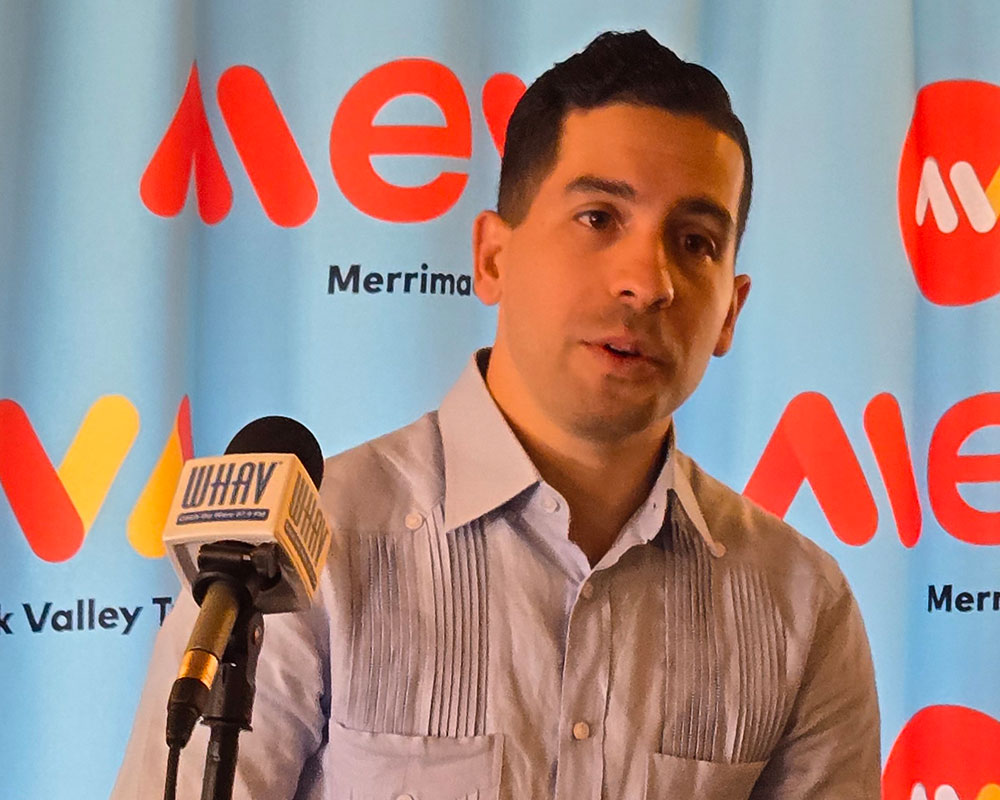
State Rep. Andy X. Vargas Monday outlined his idea for a joint management-worker committee to help sort out differences which led to the 10-day MeVa strike.
At a press conference at the transit authority’s Haverhill headquarters, Vargas was credited by management with helping the two sides break the logjam which ended the strike shortly after 6 p.m. Friday, July 10. He suggested creating an “innovation” committee to look at working conditions and then offered to serve on it.
“The idea of the innovation committee was to make sure that we had some space to have dialogue without commitments and at least start to explore different ideas and have some flexibility to put things on the table and try to deal with the different priorities that sometimes can compete. We want to expand routes, we want to help riders and we also want to make sure drivers have a living wage,” Vargas explained.
MeVa Administrator Noah S. Berger Bus said service resumed Sunday morning with higher-than-normal Sunday ridership. He said the committee’s mission will be to survey other regional buses services on their work assignment systems, but also to brainstorm new ideas.
“If someone else is doing something that works and we can show it working, I think that’s a useful thing. In other things, I think quite frankly, we will be blazing a new trail and the optimist in me says we’re going to create approaches that other RTAs, other regional transit authorities across the country, will say, ‘Wow! Look at what they just came up with at MeVa. Maybe we can adopt that,’” Berger said.
Berger said that while the city’s entire legislative delegation as well as the mayors in the five cities MeVa serves were supportive during the course of the strike, it was Vargas who rolled up his sleeves and talked to workers on the picket line to understand their grievances. Then he met with company officials to find common ground.
Jim Mark, lead negotiator for the International Brotherhood of Teamsters Local 170, told WHAV after the press conference he is cautiously optimistic the Saturday work assignment system can be resolved “in a manner of months” through new collective bargaining sessions this fall.
“We need to make sure the drivers remain whole and they don’t lose money because the option of Saturday work has been taken away,” Mark said, noting that he welcomed any effort to brainstorm new ideas.
In the end, MeVa officials accepted a compromise one-year agreement, offered initially by the union, which gives drivers and mechanics an 11.8% raise, from $29.51 to $33 per hour, but pushes off the issue of Saturday work assignments to another round of negotiations.
Noting that even within the union there are competing demands between junior and more senior drivers, Vargas said, the intention is to make the innovation committee as representative as possible, including inviting members of the community at large to participate.
MeVa’s 140 drivers and mechanics, represented by the Teamsters, walked off their jobs at midnight, July 1. The main sticking point is how Saturday work is assigned. Currently, Saturday shifts are optional and drivers who have already worked 40 hours receive overtime pay for taking Saturday work. The authority seeks to make Saturday work mandatory for some drivers because it wants to expand Saturday service. Berger said that adding more weekend service is the top request from riders.
MeVa provides free, fixed route bus service to some 13,000 riders a day in 16 Merrimack Valley communities as well as on-demand van service. It has seen a 60.8% increase in ridership since 2019, one of the few regional transit authorities nationwide which exceeds its pre-COVID-19 service levels.
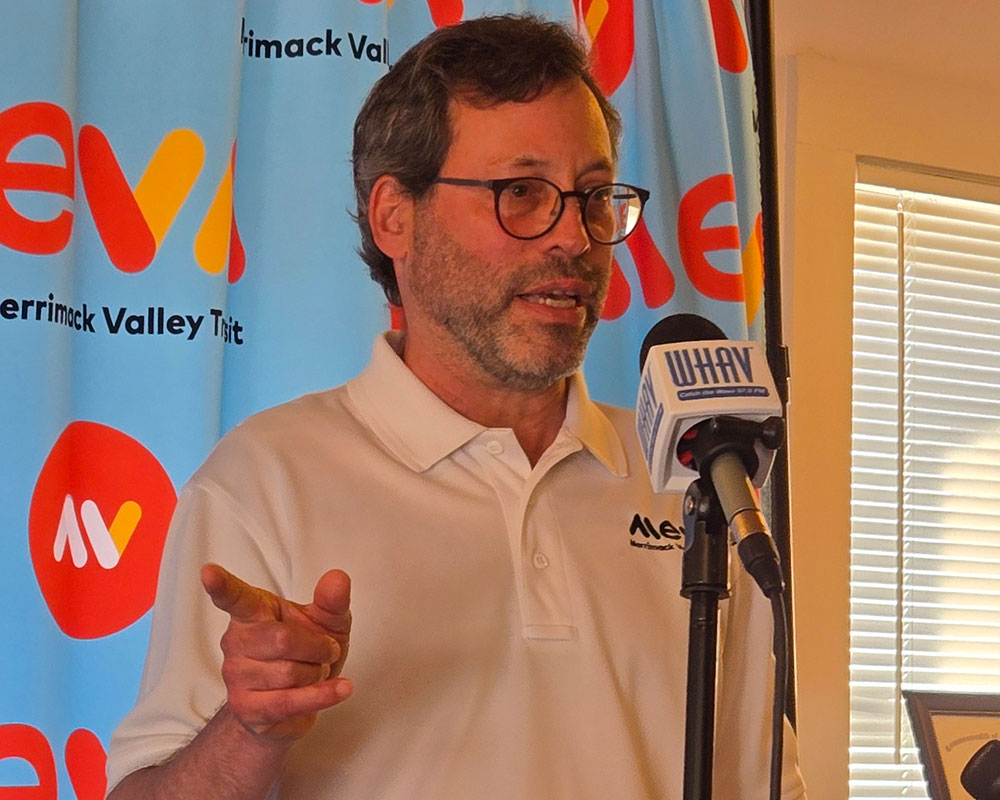
MeVa Administrator Noah S. Berger said the proposed Innovation Committee helped resolve the 10-day walkout by MeVa’s 140 drivers and mechanics. The strike ended Friday, July 10, and bus service resumed Sunday. (WHAV News photograph.)