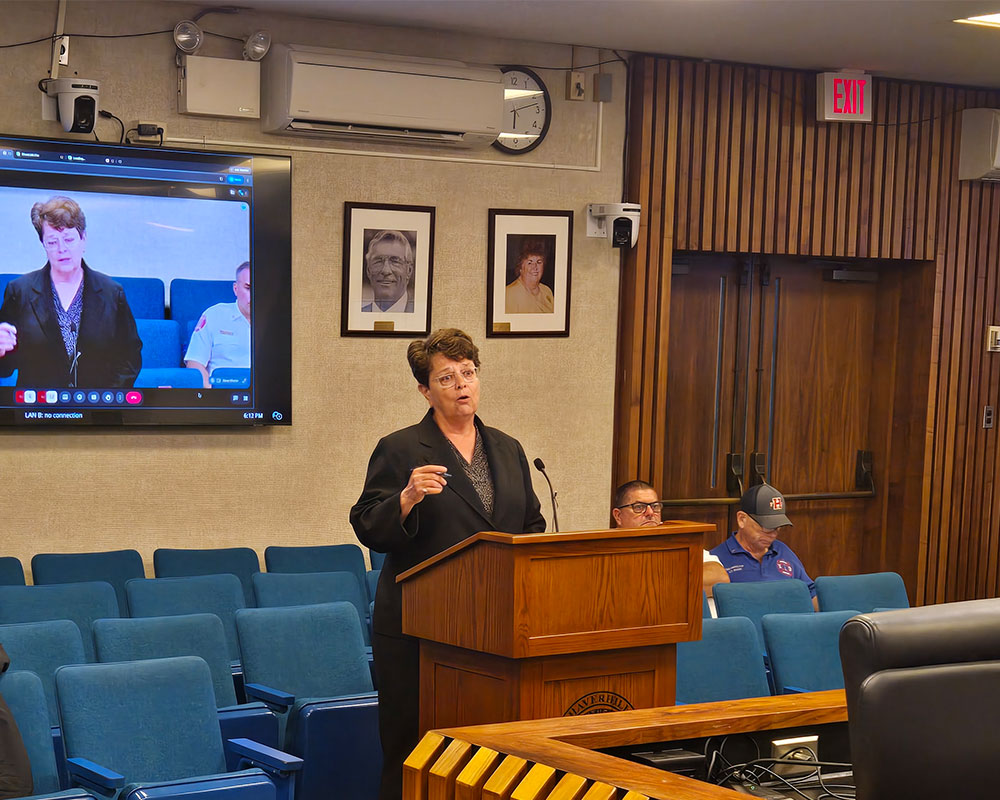

The Haverhill City Council’s Planning and Development Committee is going back to the drawing board and reconsidering where to create a zoning district that would allow large battery storage farms.
After a 90-minute discussion Tuesday, the board agreed to create site rankings and asked city officials for more information on the three to four possible locations and agreed to meet again Tuesday, Aug. 3.
As WHAV previously reported, City Solicitor Lisa L. Mead drafted an ordinance that would allow electric storage batteries only at the old Dutton Airport off Route 110 near Northern Essex Community College. The site was previously considered for a new industrial park until it was found to be a protected wetland habitat for the endangered Blanding’s turtles. Mead explained the city could use such a zone to meet its obligation to consider such industries, but still have recourse should it choose to deny proposals.
Council Vice President John A. Michitson, chair of the Planning and Development Committee, asked Mead and Haverhill City Planning Director Jacki Byerley to provide criteria they used to designate the Dutton Airport as the only potential battery site in the city.
“There is a lot of site criteria and I think the City Council, at least I am, are going to demand that we see the criteria for the selection of the site that was proposed,” Michitson said.
Christine Kwitchoff, an alternate on the Haverhill Conservation Commission, suggested the Council go one step further and grade each possible site with a report card. Michitson agreed and said he had developed a set of evaluation criteria such as distance from homes, schools, hospitals, park and playgrounds, emergency access, water protection and flooding risk.
Mead noted because battery storage areas must be near electrical transmission lines but away from people because of the noise generated by cooling fans, locations are limited. Further, she said, the fire department ruled out any land in or near the Ward Hill Business Park due to the “chemical load” of industries already located there.
City Environmental Health Technician Robert E. Moore Jr. told councilors while most of the 96-acre Dutton Airport site would be off limits because of the turtle habitat, the actual 15-acre airport land is flat and far enough away marsh areas to accommodate a battery storage facility. It is also near a transmission line and off Interstate 495.
“No matter where you go you are going to have concerns, whether it is environmental concerns or population concerns, business park concerns. I don’t think you have the perfect site for this sort of use.” Moore offered.
Councilors are under pressure to find at least one location where such an industrial use could be located because, unless it creates a zone, state law allows such facilities pretty much anywhere in the city. The farms, which look like rows of metal shipping containers filled with batteries, are used as backup energy during peak demand periods. They can store electricity from solar and wind installations, for example.