


(Additional photograph gallery below.)
The case for more housing, embrace of artificial intelligence and benefits of working collaboratively were the leading topics when the three state senators who represent the Merrimack Valley addressed the Merrimack Valley Chamber of Commerce at its annual State Senate Breakfast Monday.
State Sen. Barry R. Finegold started the morning off by arguing lack of affordable housing is dragging down the state’s economy because residents are fleeing in search of a lower cost of living. He said when he asks business leaders what he can do to be helpful to them, the top answer he hears is to build more housing in order to keep and attract talent. Noting that Massachusetts is losing population when other states like Arizona, North Carolina and Texas are growing, Finegold argued, increasing the supply of housing is paramount to maintaining a strong economy.
“There is talk about rent control. I’ll tell you right now that is not the solution. What we have to do is build. Austin, Texas. Massive population growth. Phoenix, Arizona, Massive population growth. You know what’s going on with their rentals? They are falling. Prices are coming down. Why? Supply,” Finegold said.
He added while allowing the construction of so-called “accessory dwelling units” without a special zoning permit is progress, developers still face too many barriers.
“It’s too hard to build in our state. There’s too much regulation. There’s too much red tape. And one of the things we want to do in the Senate is tackle this and make it easier to build,” Finegold said.
State Sen. Pavel M. Payano took Finegold’s plea for less regulation one step further and asked those in the room to demand more housing be built in their communities.
“Tell your local elected leaders it’s important for housing to be built within your community. Because, if not, what you are going to see is a lot of people struggling. And they are struggling right now,” Payano said.
Noting the work the local legislative delegation had done to save two hospitals in the region when Steward Health Care declared bankruptcy in 2024, Payano said the Merrimack Valley was fortunate to have hard working state representatives who work together to solve problems.
“We have an incredible, incredible team. I deeply appreciate working with both Sen. Finegold and Sen. Tarr. One of the things amongst us three that I never, never hear is ‘who’s going to take credit for this?’ It’s always about doing the work,” Payano said.
State Sen. Bruce E. Tarr, minority leader, concurred, adding that as a Republican in a majority Democratic legislature, he is proud to be part of a deliberative body that works to find bipartisan solutions.
“Even when we disagree, we find a way to work together and we find a way to keep Massachusetts state government running,” Tarr observed.
In his remarks, Finegold urged those in the room to learn more about artificial intelligence and how new technology might enhance their businesses, even non-profits.
“I’ve never seen something move so quickly. And I don’t care what you’re in. I don’t care what business you’re in. If you are not thinking, ‘How am I going to implement AI in my business?’ you are going to be left behind,” Finegold argued.
Tarr said, in his opinion, the state must recalibrate the formula it uses for distribution aid to education.
Payano said he believes free community college was a “game changer” for the state, not just for young people but also for those considering mid-life career changes. He also said that he hopes the state House of Representatives will take up an initiative recently passed by the state Senate to increase the mileage on cars eligible for coverage under the state’s “lemon law” from 125,000 to 175,000 miles. He said it might seem like a “small matter,” but that most residents in the state need a reliable vehicle to get to work.
Former state Senator Steven A. Baddour served as the event’s master of ceremonies.
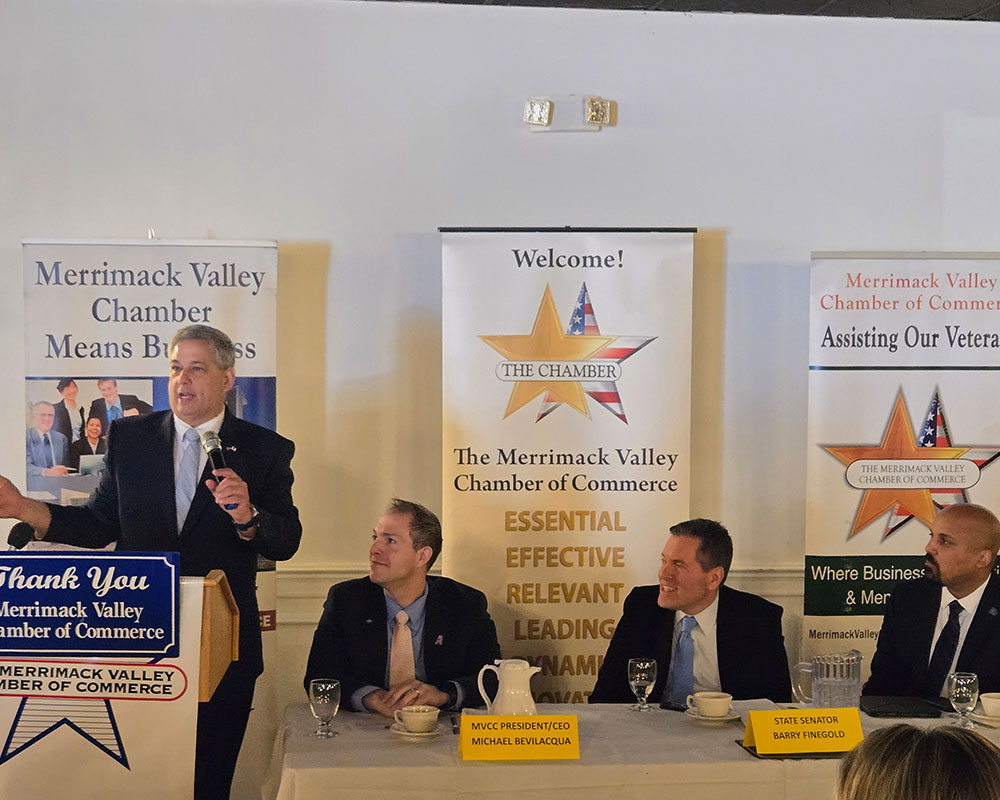
State Senator Bruce E. Tarr addresses the Merrimack Chamber of Commerce during its annual State Senate Breakfast during March of 2026. A Republican, Tarr serves as the Senate minority leader. Listening, from the left, are Chamber President Michael A. Bevilacqua and state Sens. Barry R. Finegold and Pavel M. Payano. (WHAV News photograph.)

State Sen. Barry R. Finegold at a Merrimack Valley Chamber of Commerce Breakfast. (WHAV News photograph.)
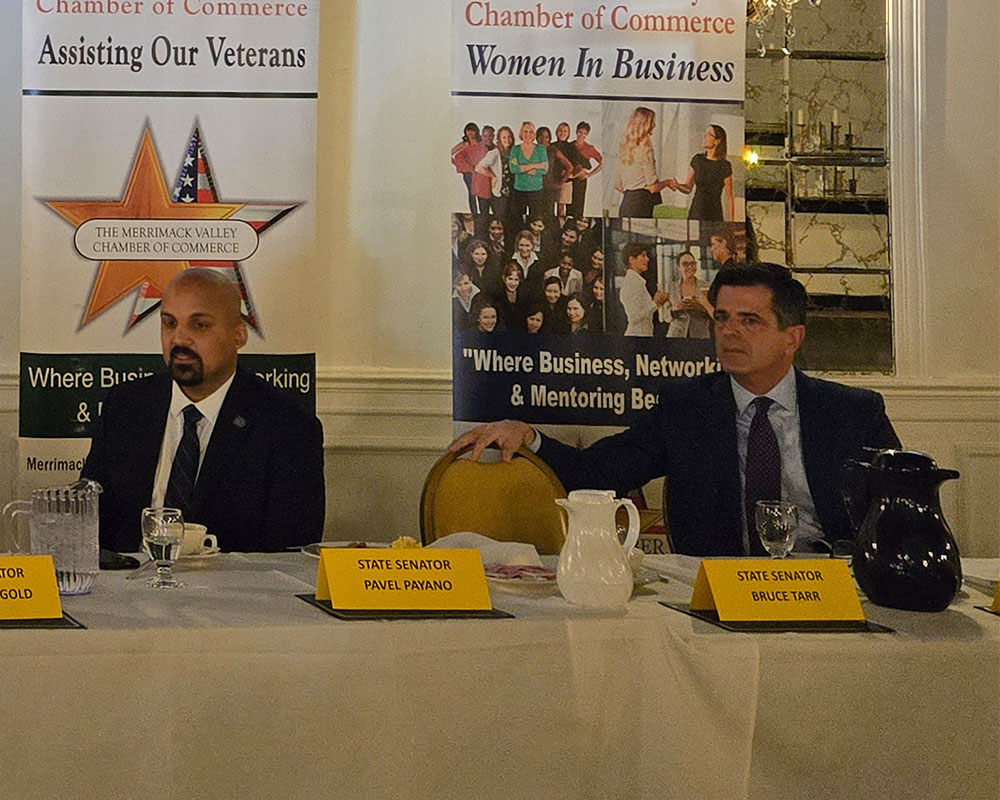
State Sen. Pavel M. Payano and former state Sen. Steven A. Baddour, who served as moderator. (WHAV News photograph.)