

(Additional photograph below.)
Six Haverhill High School students are exploring possible careers in clean energy and getting paid to do it through a partnership with the Lemelson Foundation, Massachusetts Institute of Technology and New England Invents.
Students also invited seven local companies and consulting firms to the high school and put on a Career Expo so both the Lemelson interns and their classmates can learn more about jobs in clean energy by talking to adults who work in those jobs. The companies represented were BioEchem, Casella Waste Management, MassHire, MeVa, New Ecology, Geothermal Drillers Association and New England Invents.
Junior Ariana Resto interviewed MeVa’s Dan Flaherty, assistant general manager for maintenance, and Jesssenia Fernandes, director of safety and training, and asked why the agency hasn’t moved to all electric buses. She discovered it isn’t so simple as just buying new buses. One issue Resto and her fellow interns identified is what would happen if a battery on an electric bus runs out in the middle of a route.
“So when we talked to MeVa, we put one of their issues into the clean transportation category and why they haven’t they haven’t fully transformed MeVa into all electric buses. They have problems,” Resto noted.
Paid with a $400,000 grant from the Massachusetts Clean Energy Center, students were hired as interns by Lemelson Foundation and the Massachusetts Institute of Technology.
Senior Karick Sebastian, 18, said he thinks the compensation the interns are receiving helps the students realize their work is serious. The interns are receiving $18 an hour for six hours a week through May and then will be paid for up to six weeks of 40-hour workweeks this summer.
“To me, being an intern, while being below an employee, I am still helping out all that I can to improve the community,” Sebastian said.
During their project time, the interns are developing skills in teamwork and collaboration as well as technical knowhow needed to solve real-world problems, Lombardo observed.
Sebastian said he also liked that the students have been given a clear goal to invent a solution, even if that sounds ambitious.
“We don’t have it all together yet but we will make something and we will put it into practice,” he said, confidently.
Students are spending one term meeting regularly after school to learn firsthand about clean energy jobs and the challenges brought on by the climate crisis through interviewing professionals in the field, explained Lemelson coach Brian Lombardo. They will then discuss what they learn, identify potential issues and develop what the program calls a “problem bank.” They will think through and brainstorm possible solutions that can have real world impacts. The program runs through the summer and into the next school year. Lombardo said eight more students will be invited to join the initial six interns this summer.
Students have already had one real-world impact. On a recent tour of the Merrimack Valley Transit’s maintenance building on Railroad Avenue in Haverhill, they tried out an upgrade to the current MeVa cellphone route app. Noah Berger, MeVa’s administrator, told WHAV after the students voted in favor of the upgrade, MeVa decided to install it.
Jerome H. Lemelson, a prolific inventor, and his wife, Dorothy, founded the Lemelson-MIT Program in 1994. The program focuses on expanding opportunities for all young people to learn ways inventors find and solve problems.
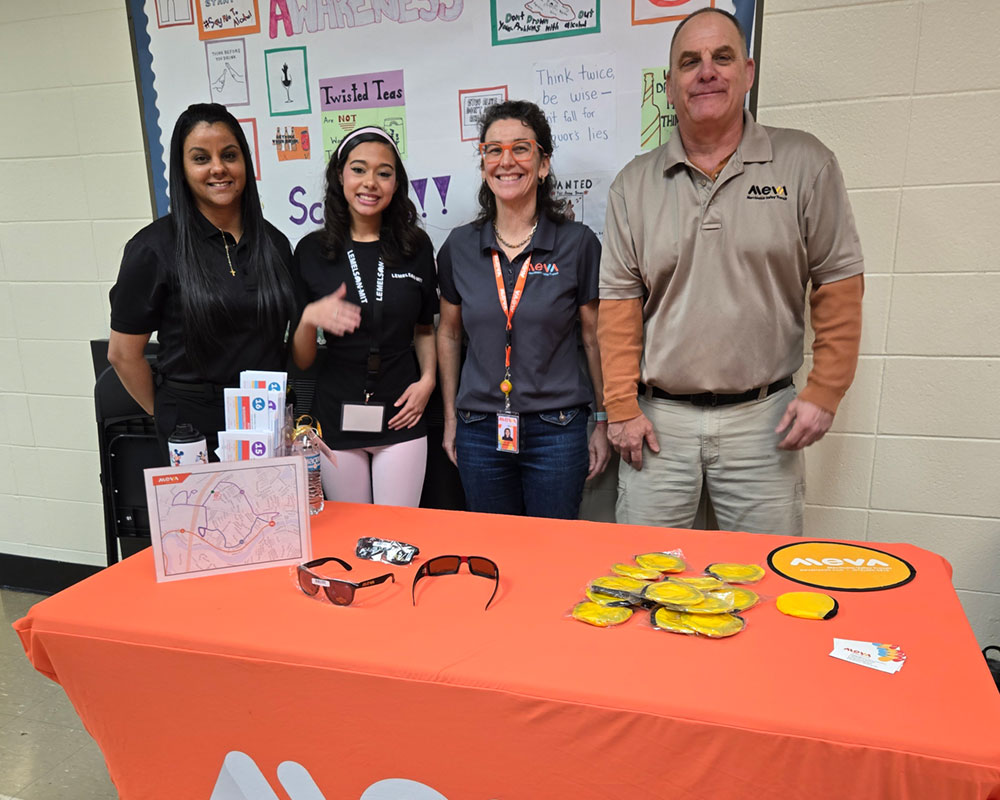
Haverhill High School junior Ariana Resto, second from left, poses with members of MeVa staff during the recent Lemelson-MIT Program Career Expo at the school. Students were given the chance to interview professionals working in clean energy jobs. MeVa staffers are, left, Jessenia Fernandes, director of safety and training; Christina Minicucci, development director; and Dan Flaherty, assistant general manager for maintenance. (WHAV News photograph.)